A Force for “Stability” (12)
 |
| An Oak with Its Limbs Sawn Off. |
Copyright Eso A. B.
When it comes to mythology, there is nothing new about men killing women. Among other things, we have the image (familiar to almost everyone) of Perseus holding the head of Medusa Gorgon by her hair in his hand.
The ancient Greeks are famous for justifying killing women by telling tales that the women they had killed deserved death, because they were or are ugly. The story about Scythian women warriors may be an invention to justify public murder of war prisoners or innocent inhabitants of a city. The women portrayed in the link look more like street demonstrators today throwing rocks, while the truly lethal arms (bow and arrows) are in the possession of men.
Where does this desire to kill women arise from?
One answer may be provided by the failure of mimesis of one sex to project itself onto the other, because of the failure by nature or social circumstances to separate the sexes in sufficiently polarized entities. In other words, a young male, home from his first kill during a hunt of reindeer or wild boar, may imagine that if he can kill a deer and boar, he can also impose on a woman himself through an unwelcome (to her) sexual act, in other words, rape. A woman may, on the other hand, extend a successful and undiscovered lie, to realize an unfulfilled desire and do violence to trust by puting the fruit of her license in her lover’s or husband’s care.
Dislike of the other sex, may be a matter of dysfunctional genes—as in homosexual men and/or women. The image projected by the mind eye of a male does not attach itself to a woman, but a man. In other words, to use poet’s (Machado) words (blog 5): “The eye you see is not an eye because you see it; it is an eye because it sees you.” The homosexual’s eye fails to be seen back by the biological eye of the other sex, but by the secreted sex. Yet again, if a woman is not desirable to a man, he may imagine her as ugly, whereas a woman may reject an impotent man as the king of her clan or tribe.
The failure of the mind’s eye to attach itself to the opposite sex, may, if met by social disapproval, find an escape through “racial” or some other social discrimination. That is: a woman smells bad, menstruates, looks ugly, is unfriendly, is poor, is black, is white, is red, has slanted eyes, etc. The reasons for rejection may be nthed to an unnatural degree if it has support from the leaders of society.
The same projections may be used to achieve attachment rather than rejection. For example, one may persuade the mind of someone yet biologically immature (generally young children) to attach itself to an object as determinedly as a gosling may attach its affections to a bathtub. In the West, this phenomenon was exploited by the Church to instil in small children a belief in Santa Claus. To make Santa ever more compelling, a whole series of stories about Christmas evolved. The stories are made all the more acceptable by connecting them with gift giving, followed by yet another story about Santa’s gift factory on the North Pole, which gifts are produced by dwarfs disguising child labor.
It is no news, that today even the Pope is complaining about the extent that the “gift” has been commodified and turned into money.
The knowledge of how to infect and contaminate a child (and humankind) did not arrive to humankind quickly. It had not yet become conscious knowledge among the natives ofTierra del Fuego in the days of Charles Darwin or Aztecs of Mexico in the days of Cortez.
Anthropologist notes and history show that primitives or arch-humankind tended to live in a social setting, where persuasion was a result of direct violence. If one escape becoming a sacrifice him- or herself, one was nevertheless compelled to go to the public square and watch the public murders of someone having their heart torn from his-her chest cavity or (if living in Europe) to hear the screams of one burnt to a crisp on a pile of wood.
It was inTierra del Fuego that men of the Selk=nam tribe persuaded women and children that the masked men masquerading before them on certain Festival days were Gods. To disbelieve the men’s performance and call out “There’s Uncle Charlie!”, got one his-her brains bashed. Before the arrival of the written word and written law, violence was a way to freeze the subjective mind and reduce an individual’s thought processes to a repetition of banalities.
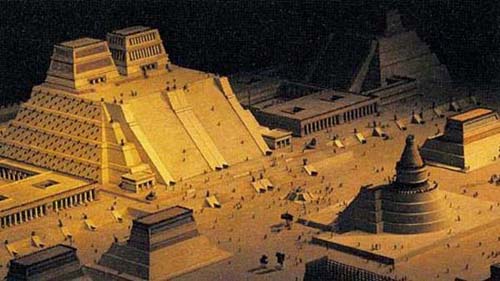
Aztec sacrificial violence was got used to and accepted, and became a social ritual. As nightmarish as miming violence may be, and as insecure the society it creates is, once violence is learned and becomes a tradition, society becomes dependent on it. Insecurity and nightmares do not hinder the social animal, but become a force for its “stability”, one that compels it to continue its violent behavior.
When it comes to mythology, there is nothing new about men killing women. Among other things, we have the image (familiar to almost everyone) of Perseus holding the head of Medusa Gorgon by her hair in his hand.
The ancient Greeks are famous for justifying killing women by telling tales that the women they had killed deserved death, because they were or are ugly. The story about Scythian women warriors may be an invention to justify public murder of war prisoners or innocent inhabitants of a city. The women portrayed in the link look more like street demonstrators today throwing rocks, while the truly lethal arms (bow and arrows) are in the possession of men.
Where does this desire to kill women arise from?
One answer may be provided by the failure of mimesis of one sex to project itself onto the other, because of the failure by nature or social circumstances to separate the sexes in sufficiently polarized entities. In other words, a young male, home from his first kill during a hunt of reindeer or wild boar, may imagine that if he can kill a deer and boar, he can also impose on a woman himself through an unwelcome (to her) sexual act, in other words, rape. A woman may, on the other hand, extend a successful and undiscovered lie, to realize an unfulfilled desire and do violence to trust by puting the fruit of her license in her lover’s or husband’s care.
Dislike of the other sex, may be a matter of dysfunctional genes—as in homosexual men and/or women. The image projected by the mind eye of a male does not attach itself to a woman, but a man. In other words, to use poet’s (Machado) words (blog 5): “The eye you see is not an eye because you see it; it is an eye because it sees you.” The homosexual’s eye fails to be seen back by the biological eye of the other sex, but by the secreted sex. Yet again, if a woman is not desirable to a man, he may imagine her as ugly, whereas a woman may reject an impotent man as the king of her clan or tribe.
This is a good place to remember that Sigmund Freud said that: “Male and female is the first distinction that you make when you meet another human being, and you are accustomed to making this distinction with unquestioned certainty”, Hirschfeld , a famous sexologists of the 20th century “posits (as per link) that a human being is neither man nor woman, but at the same time man and woman in unique and therefore unrepeatable proportions.” In other words, the “unrepeatable proportion” has to find a match, which may not in all circumstances be an easy thing to do.
The same projections may be used to achieve attachment rather than rejection. For example, one may persuade the mind of someone yet biologically immature (generally young children) to attach itself to an object as determinedly as a gosling may attach its affections to a bathtub. In the West, this phenomenon was exploited by the Church to instil in small children a belief in Santa Claus. To make Santa ever more compelling, a whole series of stories about Christmas evolved. The stories are made all the more acceptable by connecting them with gift giving, followed by yet another story about Santa’s gift factory on the North Pole, which gifts are produced by dwarfs disguising child labor.
It is no news, that today even the Pope is complaining about the extent that the “gift” has been commodified and turned into money.
The knowledge of how to infect and contaminate a child (and humankind) did not arrive to humankind quickly. It had not yet become conscious knowledge among the natives of
Anthropologist notes and history show that primitives or arch-humankind tended to live in a social setting, where persuasion was a result of direct violence. If one escape becoming a sacrifice him- or herself, one was nevertheless compelled to go to the public square and watch the public murders of someone having their heart torn from his-her chest cavity or (if living in Europe) to hear the screams of one burnt to a crisp on a pile of wood.
It was in
Aztec sacrificial violence was got used to and accepted, and became a social ritual. As nightmarish as miming violence may be, and as insecure the society it creates is, once violence is learned and becomes a tradition, society becomes dependent on it. Insecurity and nightmares do not hinder the social animal, but become a force for its “stability”, one that compels it to continue its violent behavior.